- Language
The complete guide.
The size of a racket does not refer to its length or height, which are generally standard, but to the diameter or circumference of the handle, also known as the grip.
A grip that is too small can cause an unstable hold and uncontrolled movements, while a grip that is too large limits wrist mobility and causes rapid forearm fatigue. Grip size is therefore a key factor for comfort and performance on the court.
To choose the right grip size, there are two simple and reliable methods:
|
Natural Grip:
If your ring finger touches your palm, the grip is too small. If the space is too large, the grip is too big. |

|

|
Hand Measurement:
|
Practical tip: If you are between two sizes, choose the smaller grip to ensure better maneuverability. You can then increase the handle thickness using an overgrip.

Racket weight is a key factor when choosing a tennis racket, as it influences maneuverability and power. For adult models, racket weight generally ranges between 8 and 12 onces.
However, it is important to remember that power does not depend solely on racket weight. A player's body type, skill level, and frequency of play are also determining factors when selecting the most suitable model.
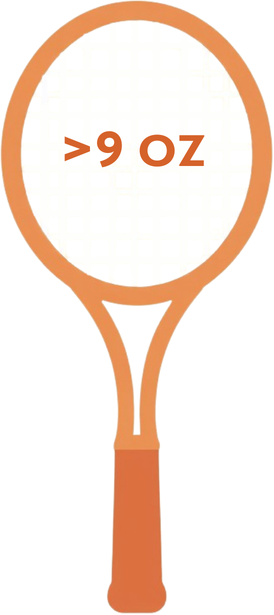
Lightweight
Suitable for occasional players. Promotes maneuverability.
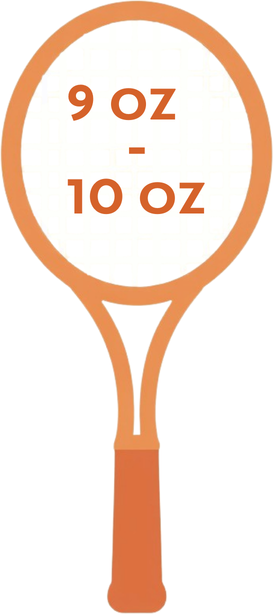
Midweight
Suitable for regular players. A balance between maneuverability and stability.

Heavy
Suitable for advanced players. Optimizes precision.

The head size refers to the stringed surface of the racket, expressed in square centimeters. Its size plays a key role in playing sensations, particularly in terms of power and control when striking the ball.
A larger head size provides a bigger hitting area, improving forgiveness on off-center shots and generating more natural power. Conversely, a smaller head size prioritizes precision and shot control but requires better technical mastery.
Small Head (600 – 630 cm²)
The small head size is designed for highly experienced players seeking maximum precision and control. Its reduced hitting surface provides excellent feel at impact but requires advanced technical skills.
Mid-Size (630 - 645 cm²)
The mid-size head offers an excellent balance between power and control. It is suitable for occasional to regular players looking for a versatile tennis racket. This head size delivers balanced sensations at impact while maintaining good comfort and maneuverability.
Large Head (660-740 cm²)
The large head size is ideal for beginner or less experienced players. Its wide string surface makes it easier to hit the ball, improves forgiveness on off-center shots, and generates natural power. This head size also allows moderate spin application while providing excellent playing comfort.
The string pattern refers to the number of vertical (mains) and horizontal (crosses) strings on the racket. It directly influences spin potential, durability, and control:

To ensure optimal performance and a long lifespan for a tennis racket, regular maintenance is essential. This includes checking the grip, monitoring string wear, and following certain usage precautions:
Game, Set and Match
Keep up to date on new products and save 10% on your next order